
Editor’s Note: The following is an article originally published on the Virginian-Pilot on November 20, 2025. With edits to match Minding the Campus’s style guidelines, it is crossposted here with permission.
The University of Virginia (UVA) is being executed by a circular firing squad. On Nov. 12, Gov.-elect Abigail Spanberger wrote the rector and vice rector of UVA’s Board of Visitors, urging “the board to refrain from making any selections of finalists or ultimately a president until” after she is sworn in as governor.
The following day, Gov. Glenn Youngkin responded with a letter to Spanberger, on which he copied UVA’s full board. The governor thundered, “I am advised that this was likely the first time in the history of our commonwealth that a governor-elect attempted to interfere with the governance of a university and the fiduciary duties of individual board members.”
The same day as Youngkin’s letter, Rector Rachel Sheridan submitted an eight-page letter to UVA’s Faculty Senate denying she helped orchestrate Jim Ryan’s resignation as UVA’s president. Ryan then responded with a 12-page letter in which he essentially accused Youngkin and Sheridan of lying. Mere hours after receiving Ryan’s letter, UVA’s far-left Faculty Senate demanded that the rector and vice rector resign “immediate[ly]” and that the search for Ryan’s successor “cease” until Spanberger is governor.
[RELATED: UVA’s Administration Is Stonewalling on Viewpoint Diversity Too]
I have no idea who is telling the truth about why Ryan resigned. But what I do know is that this entire saga that began with Ryan’s 2020 Racial Equity Task Force has caused irreparable harm to UVA, and UVA appears to have violated anti-discrimination law because of Ryan’s unwavering commitment to DEI.
Sheridan strongly implied that UVA violated anti-discrimination law under Ryan. She wrote in her Nov. 13 letter, “The community’s reaction to these events has been influenced by a widespread belief that the university has always been in full compliance with Students for Fair Admission and federal civil rights law, and that the DOJ’s investigations therefore must be entirely baseless. In fact, those issues were quite complex.” She added, “The DOJ’s letters identified a variety of concerns. Since then the university has identified hundreds of policies and websites that have needed changes to ensure that they correctly and clearly conform to the law.”
Youngkin was blunter, “The evidence is compelling that the university had repeatedly ignored the law. Former President Ryan made his intentions clear about not being committed to follow federal law, in letters and several speeches, including one to the faculty.”
[RELATED: UVA Should Set the Standard for True Equality in Education]
Ryan himself appears to have obfuscated about whether UVA violated anti-discrimination law while he was president. He wrote, “Throughout this whole episode, I learned of three potential legal issues … [T]wo were raised in our initial review of policies and practices and were arguably — though not definitely — inconsistent with the Supreme Court’s admissions decision.” He continued, “One set an aspirational goal of increasing the diversity of our faculty; one had to do with how some employment searches were run.” UVA’s former president then said, “I say these were arguably out of compliance because the court’s decision was about college admissions and applying that reasoning beyond the admissions context involves some judgment calls.”
Why do I think Ryan is obfuscating? Because, as EEOC Chair Andrea Lucas has repeatedly mentioned since the Supreme Court’s 2023 “admissions decision” was announced, “Unlike the old rules for university admissions … race or sex cannot be even a plus factor, a tiebreaker, or a tipping point in the employment context.” Indeed, except for a few narrow exceptions that don’t apply to today’s UVA (for example, taking race into account in a remedy for adjudged discrimination against people of color by the defendant in a lawsuit), it has been illegal to take race or other protected traits into account in employment decisions since the Civil Rights Act of 1964. More still: Because UVA is a public university, it is constitutionally barred from doing so.
Ryan must know this. After all, he is a law professor.
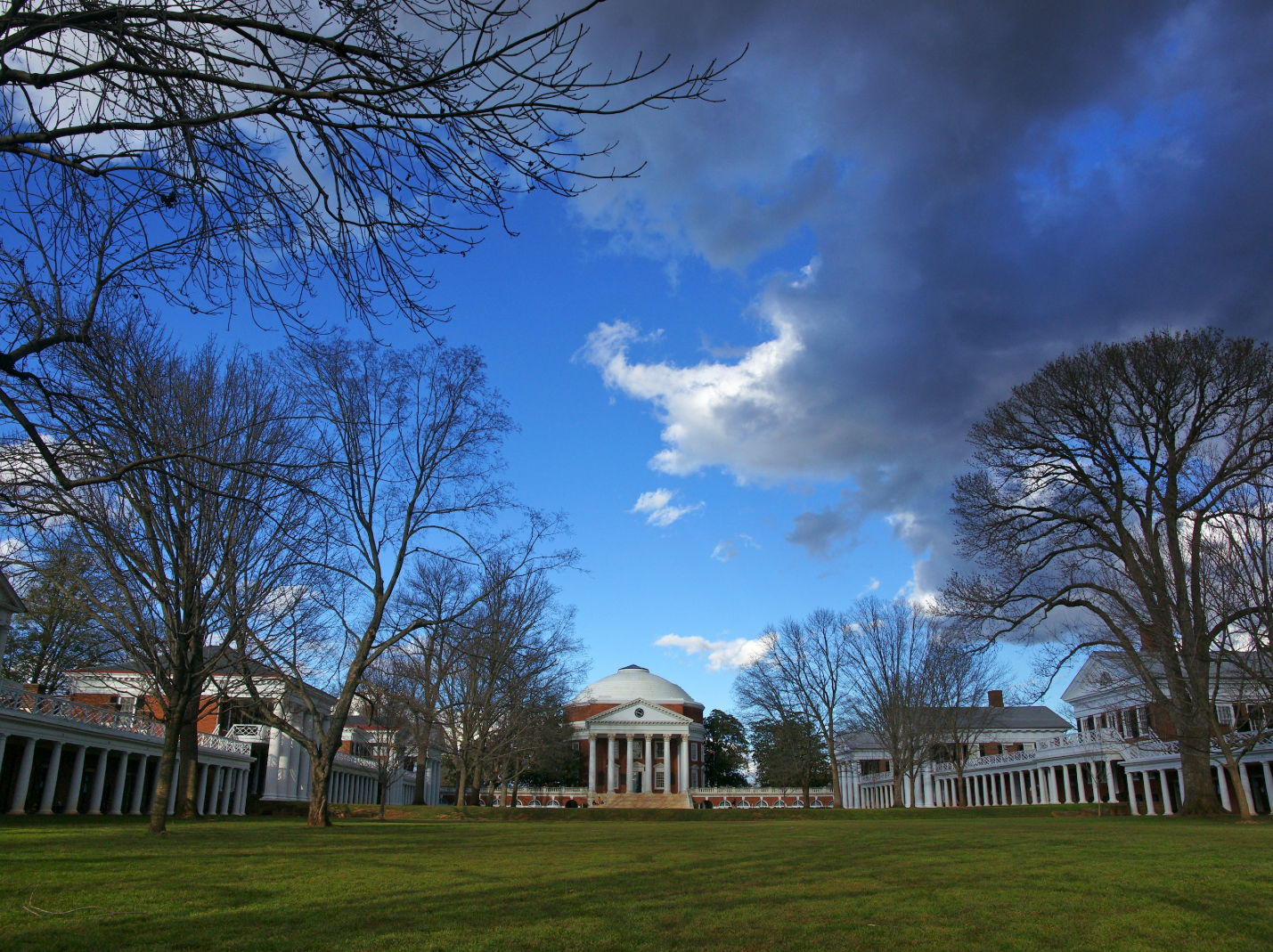
Image: “Lawn UVa Rotunda and sky 2010” by Karen Blaha on Wikimedia Commons

