Editor’s Note: On November 10th, the Phoenix, the student newspaper of Sarah Lawrence College (SLC), published an open letter signed by more than a dozen Jewish faculty and staff. The letter, dated November 2nd, responds to the federal scrutiny SLC and other campuses have faced over anti-Semitism following the events of October 7 and the protests that erupted afterward.
The signatories—self-described as representing a wide range of Jewish identities and political views on Israel—express two core concerns. First, they acknowledge that anti-Semitism exists at Sarah Lawrence, as it does on many campuses. Second, they argue that public recognition of this problem risks being co-opted by what they describe as a “heavy-handed” federal effort to portray colleges as ideological enemies and undermine higher education more broadly.
The letter rejects national media portrayals of SLC as hostile to Jewish students and defends the college’s academic culture as one where difficult conversations about Israel and Palestine can still take place with maturity and nuance. At the same time, the authors call on their own community to listen more carefully, repair strained relationships, and safeguard academic freedom and open inquiry—values they argue are essential to any meaningful campus dialogue.
Below, Samuel J. Abrams, a professor of politics at SLC, responds to the open letter.
People often ask me—students, parents, alumni, journalists—how faculty respond when a campus is in crisis. What do professors actually do when students feel targeted? How do they handle harassment, bias incidents, or the climate of intimidation many students now describe? The uncomfortable truth is that the dominant instinct is not leadership, but evasion. Faculty often retreat into abstraction, nuance, and self-protective caveats precisely when clarity and moral seriousness are most needed.
The recent letter by a group of Jewish faculty and staff at SLC is a near-perfect example of this dynamic. It attempts to intervene in a moment of heightened scrutiny, but in doing so reveals why campuses struggle to confront anti-Semitism honestly—and why so many Jewish students feel unacknowledged or abandoned.
Before now, this group issued no public statements—none—despite years of Jewish students reporting marginalization, isolation, and outright hostility. No solidarity was offered. No public defense was made. Students navigating difficult classrooms and social spaces were left to do so alone. And when the silence finally broke, what emerged was a document that reassures the institution far more than it speaks to the actual students living through this climate.
The letter opens with a detailed inventory of the signatories’ internal diversity—Zionist, anti-Zionist, post-Zionist; scholars of the conflict; faculty who lost relatives on October 7. The implication is that the breadth of Jewish identity among the authors grants them special authority and balance. But this catalog of perspectives obscures the most striking absence: the voices and experiences of the Jewish students who have felt the brunt of hostility on this campus, especially those for whom Zionism is a basic expression of peoplehood, continuity, and security. Their daily reality is the subject the letter is least willing to name.
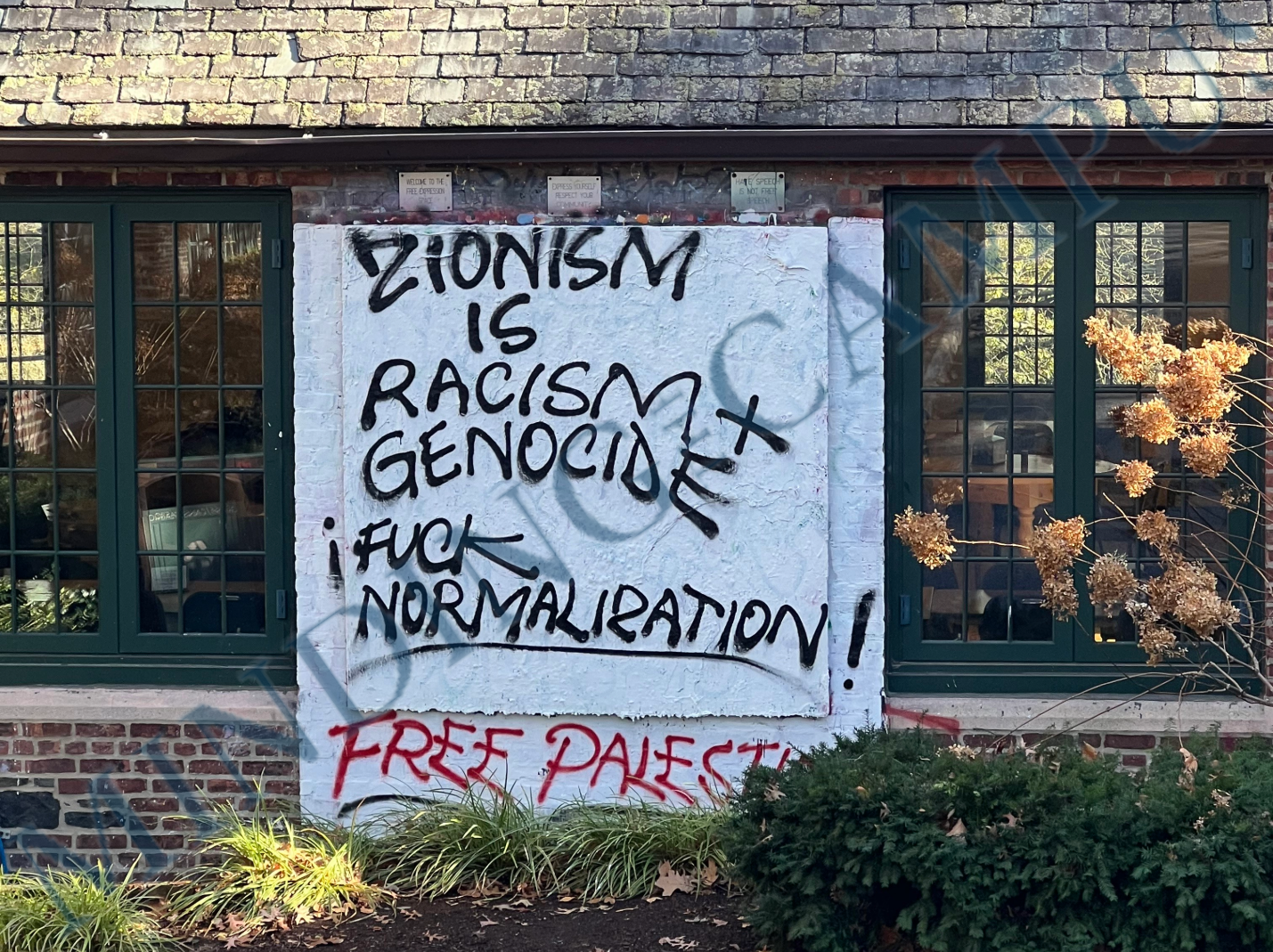
That reality is not abstract. I wrote recently in the Jewish Journal about returning to campus after Thanksgiving to find a central academic building still covered in graffiti reading “ZIONISM IS RACISM + GENOCIDE,” “F** NORMALIZATION,” and “FREE PALESTINE.” These were not posters or flyers designed to invite argument. They were accusatory declarations spray-painted across the exterior of a classroom building, aimed squarely at Jewish students—many of whom quietly identify as Zionists in the broad, nonpartisan sense of affirming Jewish peoplehood. The message was unmistakable: you are suspect, unwelcome, and morally tainted here.
[RELATED: Sarah Lawrence’s Hollow Promises—’Inclusion’ Excludes Jews]
Just above these slogans hang official plaques proclaiming “Hate Speech Is Not Free Speech” and urging students to “express yourself; respect your community.” Those institutional values, etched in metal, now sit above messages calling Jewish identity itself genocidal. The contradiction could not be starker. A college that claims to champion respect and mutual regard has allowed open hostility to occupy its walls.
And that wall has remained untouched for two full weeks. No public acknowledgment, no removal, no explanation. Students walk past it on the way to class. Prospective students pass it during tours. It may well stay up until winter break, when the college can wash it off without having to explain why it was allowed to stand. That timeline communicates its own hierarchy of concern: preserving institutional peace and avoiding controversy appear to matter more than signaling to Jewish students that they belong.
This is not an isolated incident but the culmination of years of quiet faculty disengagement and administrative passivity. Students have long described hesitating to speak in class, skipping courses, or avoiding certain professors because they know their Zionism—central to their Jewish identity—is reflexively treated as racist or illegitimate. Many simply endure, waiting for graduation to free them from a climate where their Jewishness feels conditional.
Against this backdrop, the contradictions in the faculty letter become impossible to ignore. You cannot publish a statement praising SLC as a site of respectful disagreement and mutual care while leaving unaddressed a public, unambiguous message declaring Jewish students immoral and unwelcome. Yet, that is precisely the gap the letter leaves: a glossy portrait of campus dialogue that collapses when measured against the visible, untreated reality on the brick walls of a main academic building.
What makes this omission so telling is not just the failure to condemn the graffiti—it is the priorities the letter reveals. The signatories devote far more rhetorical energy to disputing national media portrayals and pushing back on federal oversight than to naming the hostility Jewish students have been experiencing. Washington, in their telling, is “heavy-handed,” “disingenuous,” and “cynically exploitative.” The actual antagonism on campus is acknowledged only in the mildest, most generalized terms. The strongest language is reserved for defending the institution from external critique, not for defending students from internal hostility.
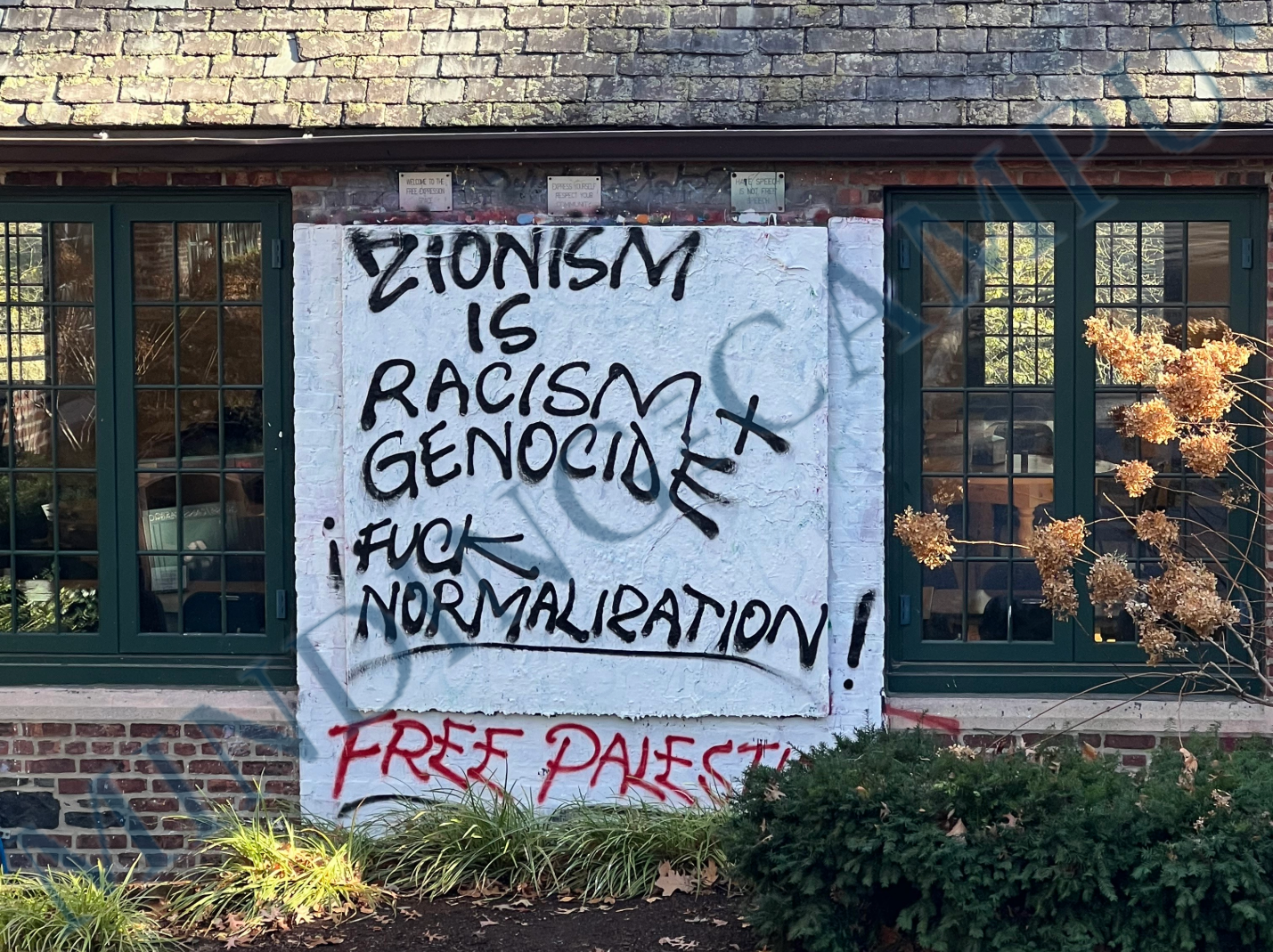
This graffiti appeared on Bates, the main student building at Sarah Lawrence College, and remained up as of December 8, 2025, according to the author.
This is the clearest evidence that the letter is less a moral statement than a reputational one. It is primarily concerned with how SLC appears to outside audiences, not with how Jewish students feel as they walk across campus. Its appeal to the “diversity” of Jewish identity among the signatories serves as a kind of credentialing shield—proof that the authors have moral range—while simultaneously allowing them to avoid directly confronting the most glaring, concrete expressions of anti-Semitism on campus.
When the authors describe campus life, the portrait is so sanitized that it bears almost no resemblance to the experiences of Jewish students. “Dialogue” does not describe what students encounter when they walk past a wall labeling their identity genocidal. “Respect” does not capture the feeling of being told they “normalize oppression.” And “care” does not apply to classrooms where students calculate every comment for fear of being marked as ideologically suspect.
Jewish students at Sarah Lawrence—and across the country—deserve better than symbolic gestures that evade the hardest truths. They deserve faculty who speak early and honestly, not only after national scrutiny forces a response. They deserve leaders who name hostility when it appears, not statements that dilute the problem into abstractions. And they deserve institutions that can distinguish between protecting academic freedom and refusing to acknowledge visible acts of hate.
The faculty letter was presented as a gesture of care, of dialogue, of moral attentiveness. But its omissions tell the real story. A campus cannot claim to protect its Jewish students while sidestepping the moments when those students are most exposed. It cannot praise itself for fostering rigorous conversation while allowing slurs about Jewish identity to sit unaddressed on the walls of a central campus building. And it cannot celebrate its own diversity of Jewish perspectives while showing so little interest in the Jewish students who actually rely on the institution for safety, belonging, and support.
[RELATED: NYU Cancels Federalist Society Free Speech Event—Then Reinstates It Following Backlash]
This is not merely a failure of communication. It is a failure of courage. And Jewish students feel the consequences every day. They watch faculty find their voice only when the institution’s reputation is on the line. They watch principles of pluralism and inclusion evaporate the moment those principles demand clarity rather than caveat. They watch adults who are charged with educating them choose institutional comfort over student welfare.
That abdication has a cost. It teaches students—Jewish and non-Jewish alike—that some forms of hate will be named and others will be managed, minimized, or ignored. It signals that the campus’s lofty commitments to openness and inquiry are conditional, enforced selectively, and abandoned when they inconvenience the wrong people.
Jewish students deserve faculty who recognize that anti-Semitism is not an abstraction but a reality—one that requires moral clarity, not strategic ambiguity. Until SLC is willing to name hostility when it appears, to condemn it without qualification, and to match its rhetoric with action, Jewish students will continue to learn an unambiguous lesson: that their safety is negotiable, their belonging contingent, and their concerns subordinate to the college’s desire for calm.
That lesson is corrosive. And it is entirely preventable. What is required is not another letter filled with balance, distance, and performative neutrality, but a willingness to say plainly what the untreated graffiti already makes plain: that Jewish Zionist identity is not up for debate on this campus, and that hostility toward it will not be tolerated. Anything less is not dialogue. It is abandonment.
Image taken by the author. This graffiti appeared on Bates, the main student building at Sarah Lawrence College, and remained up as of December 8, 2025.