
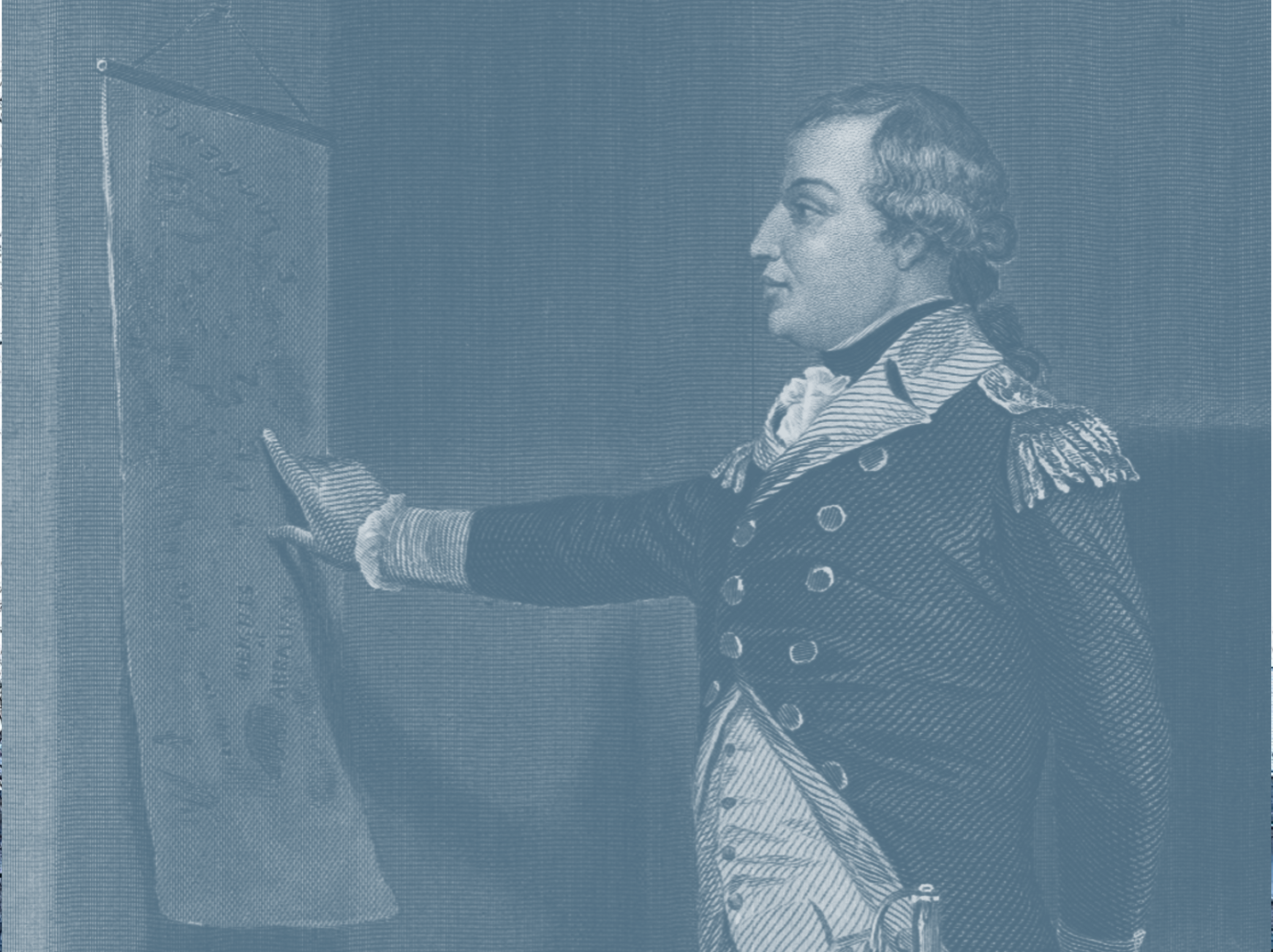
On November 13, 1775, Brigadier General Richard Montgomery led the victorious American army into the city of Montreal. He had laid the military foundation for the state of Canada to join the Union, and went off with his army toward Quebec City to finish the campaign, which did not go as planned. The Battle of Quebec would be a disastrous defeat, Montgomery would be killed, and by June 1776, the American army would retreat from Montreal, never to return. So too would the dream of the state of Canada, early and joyfully joined to its brethren from New Hampshire to Georgia.
But “joy” and “brethren” never really were in the cards. There were perhaps 90,000 people in Canada in 1775, and most of them were Canadiens, French farmers straggling along the St. Lawrence river valley, and fur traders shuttling to and from Montreal to the vast inland waterways of the continent. They had been subjects of the French empire until Britain conquered Canada in 1760, and they had no love of Les Anglais. They feared the British army, and they feared the American rabble in arms that had poured northward across the border. A few joined the American forces—although the most enthusiastically pro-American Canadians were recent immigrants from New England, not Canadiens. Some—a crucial number—joined the pro-British militia.
Mostly, the Canadiens hunkered down during the American invasion and gave it no support. The American army, in consequence, seized food and supplies, took guns from a native population it did not trust, and managed to complete the alienation of the bulk of the indigenes. The glorious cause of liberty found no purchase even 200 miles from Albany.
[RELATED: Freedom as a Gambit]
The Americans, for a moment, looked as if they might conquer by sheer numbers. The American army that took Montreal was perhaps 1,700 men, and the total population of Montreal was perhaps 12,000. Another 1,100 men were marching under Benedict Arnold from Maine to Quebec City. If British reinforcements did not arrive, that might be enough to hold for America a new-caught, sullen people, moitié diable et enfant.
But the American army melted away. Many soldiers had enlisted for only a few months; despite their officers’ entreaties, they ambled back to their farms in New England and New York. Others caught smallpox and died—they were among the first victims of the great North American smallpox epidemic that raged throughout the Revolution. The American army that would fail to capture Quebec in the December snows already had been weakened by disease, hollowed out by the American soldier’s unwillingness to leave his farm for more than a glorious escapade. America’s squandering of its evanescent victory at Montreal was partly the result of the Canadiens’ unwillingness to be Americans, partly the result of British tenacity, and partly the result of Americans’ character—ebullient, but not necessarily fitted for enduring conquests abroad.
We fought best in defense of our own liberty. So, too, in their quieter way, did the Canadiens.
Canadians still aren’t fond of overweening Americans; hence the improbable recent election victory of the liberals, whose many failures in office had seemed sure to doom them to the political wilderness. And MAGA principles may not be exportable; at any rate, Americans may not be suited to establish MAGA proconsulships among our vassals of the West. It would be pleasant if we acquired new friends—a Farage government in the United Kingdom, a Le Pen government in France. But we may be surer of acquiring them if they fight their own battles and win their own victories.
In any case, the battle for liberty at home is still a work in progress. What is most important is that we keep up the fight at home and do not go back to our farms too soon. We may hope for better times than our forefathers. History rhymes rather than repeats. Still, we may yet face a hard winter at our own Valley Forge.
When the promise of easy conquests disappears, we must be prepared to endure against adversity.
Follow David Randall on X, and for more articles on the American Revolution, see our series here.
Art by Beck & Stone

The other thing, which John Adams understood and Benedict Arnold didn’t, was that the people in Maine, particularly DownEast of Casco Bay (Falmouth/Portland). were not going to support the American cause for two simple reasons — grain didn’t grow along the foggy Maine coast, but firewood did.
The British burned an awful lot of firewood, and they paid cash for it. And it was far easier to sail it down 200 miles from Maine than it was to lug it over the 30 miles of rutted dirt roads from where the Massachusetts frontier began.
So what they would do is sail down cordwood and either trade it for flour or sell it to the British for cash and buy flour — which they took back with them. There are records of people coming from as far away as Machias. They might have brought down some salt cod as well, but as John pointed out to Abigail in a letter I read, they were depending on this trade because they couldn’t grow the grain locally.
As John pointed out to Abigail in a letter I read, these people depended on this
One other thing though — the British initially thought that Arnold was going for Nova Scotia and put Halifax on alert. When they learned that he was in Waterville (actually Winslow, the fort was on the other side of the river), they instead realized that he was going to Canada.
Hence the concept of going up the Kennebec and then over & down into Canada wasn’t unique to Arnold — although it wasn’t the same thing as going up the Hudson. But apparently no one knew that at the time…
The ultimate irony here is that there was a great deal of support for a revolution in Nova Scotia, which had largely been settled by people from New England. It would decline due to the priviteers, and then the Loyalists who fled Boston, but there was a serious discussion of invading Nova Scotia.
The locals would have been more friendly, but the British naval power more effective, although doing this before March of 1776 would mean that the Royal Navy would have been split between Halifax and Boston, with a greater interest in the latter.
And the real question is if they could also drive the British out of Halifax — that’s a big “if” because it wouldn’t have been possible to bring cannons in the way Knox did to Boston — then they could have taken a harder line on slavery and risked losing South Carolina and/or Georgia — and those two ports because the British wouldn’t have had the strategic port of Halifax.
Address slavery in 1776, no Civil War in 1861, no strong Federal government, and who knows what would have happened…
Of course if Andrew Jackson hadn’t won the Battle of New Orleans and the Hartford Convention had actually led to a New England/New York secession, who knows…
Arnold’s mistake was going up the Dead River.
Maine’s Upper Kennebec Valley is such incredibly rugged territory that much of it is wilderness to this day. The only road through there follows the shore of the Kennebec River, until it gets to The Forks where it follows an Indian path overland instead of the Dead River, which splits off here.
Arnold should have asked himself why the Indians didn’t take the Dead River — my guess is that there are two reasons. First, all lakes eventually fill in to become swampy bogs and the lake which had once been at the head of the Dead River was such a bog. And second, the Dead River was notorious for flash floods, one of which Arnold encountered and became one of his many setbacks.
I say “was” because Flagstaff Lake was created (out of the town of Flagstaff) to control flooding on the Dead River so as to protect the hydro dams downstream.
The other thing is that they really didn’t understand geography at this point — while the Hudson and Connecticut Rivers run south, the New England rivers, i.e. Merrimack to Penobscot, run to the eastward. So even when Arnold got to a place where the ground started going downhill, and even though he was going northeast, he was on a trajectory for Quebec City and not Montreal, which was further up the St. Lawrence River.
I’m sorta surprised that he made it with any of his men.
Then a few years later he would make the mistake of going up the Penobscot River, getting trapped in it and having to scuttle his ships in what is now Downtown Bangor when he hit the fall line. Hiking back from Bangor would have been a whole lot easier than hiking back from Quebec….